
Develop stronger partnerships and programs with two new LiFT courses

WebJunction published the final two courses in the Community Engagement series of the LiFT (Library Foundational Training) program:
· Introduction to Partnerships
· Community-Engaged Programming
This completes the four-course Community Engagement series, which leads the learner through the intentional practice of building strong relationships between a library and the community for the betterment of both. Building on the first two courses in the series, these new courses explore two ways libraries can practice community engagement: by developing partnerships with community groups and by collaborating to co-create programs with community members. The approaches to community engagement introduced in these courses can help libraries better understand community values and strengths.
Introduction to Partnerships
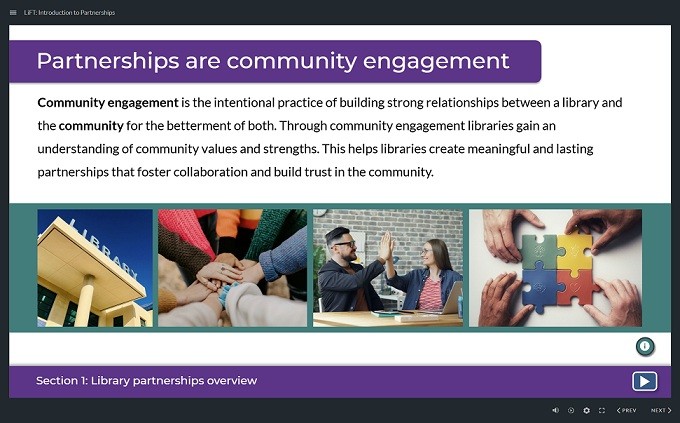
Introduction to Partnerships shares why libraries partner with community organizations. These collaborations help libraries reach beyond their walls and strengthen community connections, benefiting the library, its partners, and the public.
The course defines a public library partnership and explains the different ways it could look based on how responsibilities are shared, how long they last, and how formal they are. Partnerships should always support the library’s overall strategy and mission and provide meaningful value for all involved. To achieve this, the course outlines how to address principles of mutual value, clear communication, and adequate time and resources when developing a partnership. Learners explore a partnership’s lifecycle, which emphasizes the role of evaluation throughout the process.
Developed with course consultant Cindy Fesemyer (co-author of Small Public Library Management), this course is full of varied examples, illustrating what partnerships can look like for different libraries and communities. One of the early testers commented, “I liked all the examples. It was great to see the action steps spelled out clearly with realistic partnerships.”
Community-Engaged Programming
Community-Engaged Programming proposes that the most meaningful programs often come from strong relationships and shared decision-making. Community-engaged programming is a collaborative approach in which community members actively participate in co-creating programs with the library. This course builds on the previous Community Engagement courses in the series by focusing on a specific approach to library programming that aims to engage the community in a meaningful way.
Developed with course consultant Audrey Barbakoff (co-author of The 12 Steps to a Community-Led Library), this course argues that creating programs with—and not just for— the community helps the library build trust with underserved communities, reach people who don’t usually use the library, and increase attendance at library events. The differences between community-engaged, consultative, and library-led programming are explained and illustrated with practical examples. This type of programming relies on effective collaboration, and the course outlines several key elements to ensure successful collaborative planning, evaluation, and implementation. Learners are encouraged to embrace the discovery that happens in community-engaged programming and to acknowledge that it can be complex and messy, yet transformative.
One early tester remarked, “[The course] covered an area of programming you don’t typically see in webinars or conference sessions. I've been doing library programming for many years, and this course had new content for me.” Another tester noted, “I liked the clear, simple instructions for community-engaged programming. It established relevance and used engaging examples to highlight practical use cases.”
Find additional learning resources and enroll
Because partnerships and community-engaged programming look different in every library, both LiFT courses include an activity and discussion guide to help you work through the material with peers and apply it to your own situation. Additional resources are available to explore these topics more deeply. If you complete all courses in the Community Engagement series, you will earn a badge, which you can add to your LinkedIn profile or digital backpack. Sign up for these courses today!