
Build community engagement skills for everyday library work with LiFT courses

Community engagement is not a single program, event, or department. It is an ongoing practice of listening, learning, building relationships, and working alongside community members to help the library better serve everyone. Engaging with the community makes the library’s work more meaningful and effective. When you listen and build relationships, you learn what people value and want to achieve. This means the programs you run and the services you offer are more likely to make a real difference.
WebJunction offers two self-paced courses designed to help public library staff and leaders build the knowledge, skills, and confidence to make community engagement part of their everyday work. These are part of the LiFT (Library Foundational Training) suite of courses.
Developed with course consultants Audrey Barbakoff (author of The 12 Steps to a Community-Led Library) and Cindy Fesemyer (co-author of Small Public Library Management), these courses recognize an essential truth: everyone has a role in community engagement. Whether you work at a service desk, plan programs, manage communications, supervise staff, serve on a board, or lead a library system, your interactions and decisions can strengthen the library’s relationships with its community.
Start with the foundations
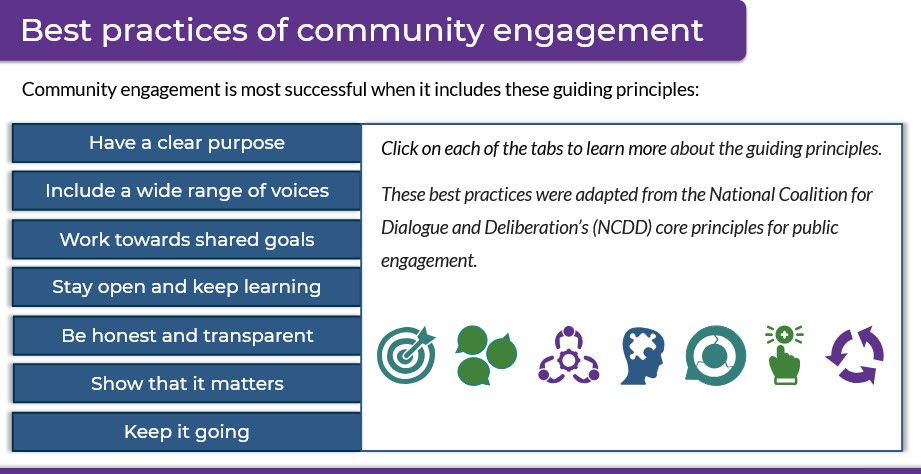
Introduction to Community Engagement offers a clear, accessible starting point for anyone who wants to understand what community engagement looks like in a public library. Community engagement helps your library become more relevant, trusted, and impactful. When the library has meaningful relationships with the community, it can create services the community knows about, cares about, and uses. Engaged communities participate more actively. Libraries with strong community connections see more visits, more library cardholders, more program attendance, and higher circulation numbers. People begin to think of the library as their place, which builds long-term loyalty and support.
In this course, participants will:
- Define community engagement.
- Identify methods of community engagement.
- Describe the benefits of community engagement for both the library and broader community.
- Understand the importance of communication, building trust, and authentic relationships with community members.
- Describe how data gathering, marketing, and outreach efforts are enhanced with community engagement.
When libraries build authentic relationships with community members, they gain a deeper understanding of community priorities, experiences, strengths, and aspirations. In turn, community members can better understand the library, contribute their perspectives, and help shape services that matter to them.
A central focus of the course is the importance of communication, trust, and authentic relationships. Community engagement goes beyond informing people about what the library has already decided to do. It involves creating opportunities for meaningful two-way conversations, listening with curiosity, and showing that community input can influence library decisions and actions.
The course also examines how community engagement enhances three activities that are sometimes treated as separate: data gathering, marketing, and outreach. Rather than seeing these as steps in a one-way process, staff will learn how these activities can work together in support of stronger community relationships. For example, conversations during interactions at the reference desk can help a library collect useful information, identify communication needs, and develop messages that resonate with the people it hopes to reach.
Early testers found the course clear, straightforward, and easy to understand, including for people without a library background. One tester especially appreciated the real-world examples, noting that they made the concepts easier to grasp. Another highlighted the course’s explanation of the connections between marketing, data, and outreach, saying it increased their confidence in applying all three together in their role.
Lead engagement intentionally
While all staff members can contribute to community engagement, library leaders have a particularly important role in creating the conditions for it to thrive. Community Engagement for Leaders helps directors, managers, supervisors, board members, and other library leaders take an intentional, systematic approach to building strong relationships between the library and its community.
This course explores how community engagement helps leaders understand what the people they serve truly value and hope to achieve. That understanding can guide programs, services, partnerships, and strategic priorities, helping the library meaningfully impact their community.
By the end of the course, participants will be able to:
- Identify and document important community resources, relationships, and trends
- Determine key individuals to engage
- Begin planning conversations and engagement activities
- Identify opportunities for staff, volunteers, and board members to share the engagement load.
These learning outcomes ensure all leadership roles can support community engagement as a priority at their institutions over time.
The course introduces practical tools to help library leaders begin or strengthen this work. An engagement inventory helps participants review current marketing, outreach, and partnership activities and consider whether those efforts deepen community engagement. A community profile and community map provide a foundation for understanding the people, organizations, assets, relationships, and trends that shape the local community.
Participants will also explore the importance of being present in the community: getting out of the library, talking with people, and developing relationships. Trust is essential to this work—and trust is built and maintained through consistent, respectful action.
A workbook for turning learning into action
Community engagement often requires a shift in mindset and approach. That kind of change can take time and be messy. The leaders course includes tools to help participants move from ideas to long-term action.
The accompanying Community Engagement for Leaders workbook is a hands-on companion that allows learners to apply the course content directly to their own library and community. By completing it, participants will create a set of usable resources, including an engagement inventory, community profile, community map, prioritized list of key contacts, preparation for strategic conversations, a list of assumptions, a focus area for change, and a first step to begin.
A course tester described the workbook as “thorough, well-organized, and structured” in a way that supports long-term goal setting. They noted that it provides valuable guidance for people who may feel overwhelmed about where to start.
Building community engagement practices that last
Community engagement is not something libraries have to take on all at once. It can begin with a conversation at the service desk, a new relationship with a community organization, a question asked at a program, or a closer look at who is and isn’t participating in the library’s work. From foundational learning that helps library staff apply community engagement in their everyday work, to tools that can help leaders build a more intentional, sustainable approach across their organization, WebJunction’s two new courses offer a starting point for library staff in any role.
Strong community connections take time, curiosity, and a willingness to listen and learn. By making community engagement part of how the library works, staff and leaders can build relationships that help them better understand their communities, respond to what matters to them, and deliver powerful services and programs over time.