Bridgebuilding Case Study: Topeka & Shawnee County Public Library
This case study was developed by IREX as an example of a "bridgebuilding" activity. Bridgebuilding, or bridging, is when different types of people come together with respect and understanding. It helps build trust and work towards shared goals. Over time, it can strengthen communities and create a more welcoming, connected society.
Background
Topeka & Shawnee County Public Library (TSCPL) is a public library serving Shawnee County, Kansas. Shawnee County has a diverse population and a range of community needs, including food insecurity. TSCPL has long served as a central gathering place and resource hub, and Community Connections Librarian Lissa Staley’s approach to programming has always had a bridging focus. Whether hosting a book club or a trivia night, she believes in creating space for people to meaningfully connect and is famous for employing bridging strategies like bringing too few pairs of scissors to a craft night to force patrons to ask each other for them. “If my programs aren’t a little awkward for everybody there,” she said, “it probably wasn’t a very good library program.”
With a new strategic plan emphasizing connection as a core pillar, the library sought to move beyond traditional programming and intentionally foster deeper community relationships.
As Lissa explained, this required rethinking how success is defined: “We tell ourselves that if people come to a program, it’s a success,” she said. “But this project helped us ask: what does real connection look like? How do we measure it? How do we build it intentionally?”
What the library was exploring
The library wanted to learn how they could best serve as a connector—linking community members to local resources, volunteer opportunities, and each other. They wondered if they could design a program that both helps people find food resources and builds trust between people from different backgrounds.
Through a grant from IREX, the library designed Community Resource Connector activities that invited people to help assemble and share accurate local food resource information. These activities were intentionally small and practical, lowering the bar for participation and focusing on shared action rather than facilitated dialogue. Alongside the activities, the library used short surveys and trust indicators to better understand who participated, who did not, and how people experienced the interaction.
“You don’t have to do something big,” Lissa said. “You just have to make it easy for people to help each other. That’s where the magic happens.”
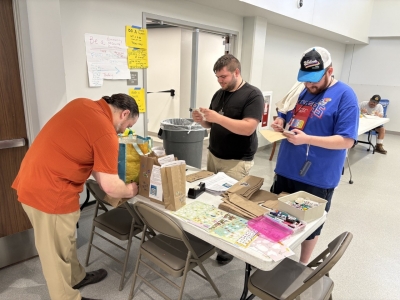
In the second round of experiments, Lissa made a critical pivot. Rather than trying to draw people to the library, she went to Let’s Help, a social service agency that serves hot meals three times a week. The organization had recently moved to a new location and had seen an increase in people coming for lunch, many of them the “working poor,” people who have jobs and places to stay but still come for the meal. The space brought together both meal recipients and volunteers from church congregations and community groups who cook and serve, creating a natural environment of socioeconomic mixing.
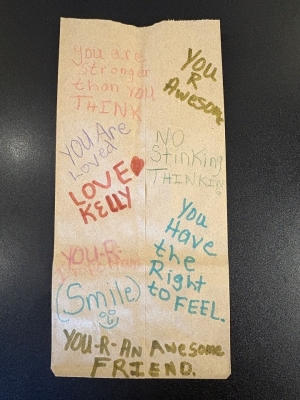
The activity was designed with dignity at its center. Participants made a snack bag for themselves and one to give to someone else because, as Lissa noted, “asking people who are hungry, who are coming to a free meal, to only serve others felt really icky to me.” They got to choose what snacks to go in the bags, decorate them, and take food resource information for themselves. Everyone who participated and completed a survey received a $10 grocery gift card as a powerful incentive because food-insecure people are typically given food they don’t get to choose. The choice element motivated participation from everyone, including people who couldn’t read (who worked with someone else to fill out the survey) and people uncomfortable being near others (who met someone off to the side).
Results
Early on, Lissa noticed that very few people were showing up to the initial Community Resource Connector events held at the library. Rather than treating this as a marketing issue, she treated it as data. The low turnout raised deeper questions about access and capacity. Who can carve out time to attend a standalone library program, and who can’t? Who feels comfortable walking into the library for this kind of activity, and who doesn’t? Lissa effectively pivoted to addressing this challenge and, as a result, across the five events, the Community Resource Connector work reached approximately 436 people through a combination of in-person activities, community distribution, and social media engagement. 89% of participants reported that they were willing to teach or share knowledge with others in the community, and 96% said that they felt welcome at the events. 77% of participants agreed that “today felt collaborative—we worked toward a shared goal.”
“My learning was often around the idea that people are eager to be part of things that are good and helpful right now,” Lissa said, “even and especially if they don't have the mental, financial, or emotional capacity to organize or plan the things, but they can join for a bit.”
The Let’s Help event was, in Lissa’s words, “transformative.” By the time participants reached the open-ended survey questions, enough in-person rapport had been built through the craft activity that “they spilled their guts and it was amazing.” Participants didn’t just engage individually; they explained the project to each other, helped each other access the activity table, and advocated for the work to fellow attendees. “It was not just ‘you can get the gift card,’” Lissa said. “People explained to each other what the project was and… why it was important.”
The work kept momentum as Lissa continued to share updates through social media and “everybody [was] getting to see everybody else helping publicly on Facebook.” When Lissa posted a draft food resource guide on Facebook asking for feedback, approximately 100 strangers interacted with it, who Lissa says, “are not the usual suspects in [the library’s] community engagement.” One person went through and looked up all the bus stops for every food pantry in the community and posted them in detail with advice. The group collaborated to create tailored guides for accessing food resources in the community. Multiple neighborhood improvement associations requested localized versions for their areas, leading to plans for editable Google Docs that communities can co-own and update. Real volunteering grew out of this work too. When Lissa organized a sandwich giveaway on Memorial Day — when many community resources were closed — community members independently showed up with bread and peanut butter to help. A person who happened to walk by and ended up helping with food distribution later invited Lissa to speak to her community group because they wanted to get involved in similar volunteer activities.
Key learnings
Attendance itself was a form of information. Lissa realized that asking people to prioritize a separate event was filtering out those with fewer resources or less flexibility.
- Location shapes who participates. Staying at the library and trying harder was unlikely to change the audience. If the goal was to build trust across difference, the work had to move into spaces people were already using, especially food resource centers and community service sites during pickup or service hours.
- Capacity is a trust consideration, not just a logistics issue. Through observation and survey administration, Lissa saw that some participants were hesitant to engage with written surveys or formal asks. Designing for trust meant adapting how questions were asked, where they were asked, and how much was asked of people in the moment.
Small design choices had outsized effects. Reducing participation to a few minutes, embedding the activity into existing routines, and allowing people to join informally changed who engaged.
Trust the community to crowdsource solutions. When Lissa posted a draft resource guide and asked for help, the community responded with detailed contributions like bus stop information, neighborhood-specific suggestions, and personal experiences. Making resources editable and community-owned generated far more engagement than any library-produced guide could alone.
Resources must be in the languages people read. At the very first event, a participant said bluntly: “This is not in Spanish. I do not care.” He couldn’t use it with anyone he wanted to share it with. Translation of all food resource materials is now a priority.
Why it matters
Approaching this work with an explicit goal of building trust changed how the library thought about these activities. It forced them to be more conscious of who was in the room and how comfortable they were feeling. It helped the library identify gaps they might otherwise have overlooked and led them to make changes that made their activities much more impactful. Lissa is eager to share these learnings with other staff within her library and to help them find simple ways to prioritize trust building and bridging more. For example, she’s asked her library to buy thousands of nametag stickers that patrons can decorate for themselves and invest in some sturdy nametag options that customers could reuse every time they return to a library activity, to help build a sense of continuity and belonging. Lissa is also developing training for the library’s staff training library to help colleagues apply a trust lens to everyday programs, focusing on participant experience and small design choices that influence connection including icebreakers as people enter, conversation time throughout, and intentionally inviting participants to take on small leadership roles. The Community Resource Connector work has generated momentum well beyond the original grant scope. The model is already expanding, for example, during a tornado warning, community members tagged Lissa suggesting the same approach for tornado shelters, and she consistently responds, "we as a community could definitely work on that together." Meanwhile, an existing blessing box network has grown informally and organically, with new volunteers independently filling boxes, redistributing supplies, and coordinating deliveries. This peer-to-peer model represents the kind of sustained, relational information sharing and connecting the library hopes to cultivate at scale.
Library details
- Library name: Topeka and Shawnee County Public Library
- City, State: Topeka, KS
- Size of library system: Single-county public library serving Shawnee County, Kansas
- Contact for bridging work: Lissa Staley, Community Connections Librarian, [email protected]
Use this case study to learn:
- how Community Resource Connector activities can build trust through shared, practical action rather than facilitated dialogue
- about pivoting from library-based events to engaging people in spaces they already use, such as social service agencies
- how to design programs with dignity at the center, ensuring participants benefit alongside those they help serve
- about treating low attendance as data and using it to surface deeper questions about access and capacity
- how to crowdsource and co-own community resource information through participatory, iterative approaches
- about using trust indicators as a long-term framework for embedding intentionality into everyday library programming
This resource was created by IREX through a project made possible with support from More Perfect,
Rockefeller Philanthropy Advisors, and the Walmart Foundation.