Bridgebuilding Case Study: Pottsboro Area Public Library
This case study was developed by IREX as an example of a "bridgebuilding" activity. Bridgebuilding, or bridging, is when different types of people come together with respect and understanding. It helps build trust and work towards shared goals. Over time, it can strengthen communities and create a more welcoming, connected society.
Background
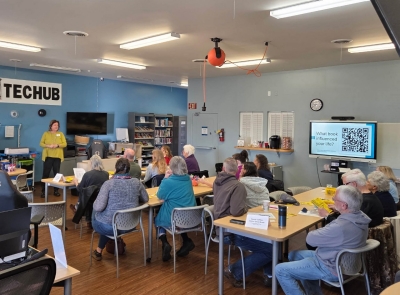
Pottsboro Area Public Library is the heart of Pottsboro, Texas, a small rural town of just under 3,000 people an hour-and-a-half north of Dallas with no local news outlets. Big changes are coming to the community, with substantial tech investment happening in nearby communities, but many members of the community are disconnected from one other and lack an understanding of how to work together to influence their community’s future. The library is the primary hub for connection and information, running the town’s Facebook and Nextdoor pages and buying equipment to enable the city council to livestream their meetings.
According to Dianne Connery, the library’s Development Director, Pottsboro Area Public Library, is trying to shift “the conversation from ‘someone should do something about this’ to ‘oh, who are we waiting for? We are the people who can do something about this.’
What the library was exploring
The library has been increasingly organizing civic engagement activities—events designed to get residents involved in their community—but wanted to make them better. Their goal was to bring in a more diverse group of attendees, help people feel more connected, encourage residents to get more involved in the community, and get better at measuring how effective these efforts were.
Through a grant from IREX and support using its Research to Change methodology, the library organized a series of community discussions designed to strengthen trust, foster civic engagement, and bridge divides across diverse groups.
As part of these activities, they tested different outreach techniques, such as direct one-on-one outreach, changing the language they used to market events, and whether bringing people together to talk and work together would make them feel more connected, valued, and willing to get more involved in the library and the community.
In the second round of experiments, the library partnered with Braver Angels, a national nonprofit focused on depolarization, to deliver a structured workshop called “Depolarizing Ourselves.” The curriculum helped participants recognize that “the other side” is not one monolithic group where a range of opinions and lived experiences bring people to their beliefs. Connery felt that partnering with a recognized national organization gave the program extra credibility.
The library also tested a new outreach approach, using Eventbrite for registration instead of the library’s usual system, combined with BCC emails designed to feel like personalized invitations. Multiple attendees reported that receiving what felt like a personal email was specifically what motivated them to attend.
The two rounds offered an instructive contrast in framing. The first round featured side attractions such as a local coffee shop and positioned the conversation as a companion to a broader, more casual event, drawing bigger and more diverse crowds. The second round was more explicitly focused on civic engagement and depolarization, even using the provocative social media tagline “Talking about politics at the Pottsboro Library?” This drew smaller but more intentional audiences, and the library’s trusted reputation meant people were willing to engage rather than avoid it.
Results
The library’s first round events had a strong and enthusiastic turnout. Participants reported feeling respected, included, and eager to return. Many stayed after events to continue conversations, signaling a strong desire for connection. 90% strongly agreed that people took turns and listened without interrupting, 62% that others tried to understand their point of view, and 95% felt welcome.
The second round of activities drew 11 participants. Participants noted that even though they might sometimes want to avoid political conversations, they decided to attend because they trust the library to host balanced, welcoming discussions. As one regular attendee put it, “I know whatever you all are doing, it’ll be a quality program.” Participants shared that they really appreciated “talking without arguing” and that the event “helped me get out of my mindset to just not talk to 'That Group.'”
One meaningful moment came when a city council member attended and shared his frustration about residents criticizing decisions on Facebook without understanding the decision-making process or reaching out to city government directly. The informal library setting allowed him to share this personal viewpoint in a way that opened up dialogue rather than shutting it down, something unlikely to happen at a formal public meeting. This conversation also generated tangible civic action. Two attendees expressed interest in starting a “communication asset map” for Pottsboro to figure out how all community members, whether they use Facebook or not, can receive information about what’s happening locally. This represents a meaningful step toward addressing the town’s communication gap.
Key learnings
- Updated framing draws more diverse audiences. Traditional events can benefit from updated framing that incorporates topics of great interest to broader members of the community. Pottsboro’s approach to advertising events as skills building practice using emerging technology, including AI, to help ideas and plan for future community events was much more successful at drawing in a diverse crowd. By contrast, advertising that used a more traditional focus and language for community events to brainstorm future activities, like “civic pride” and “togetherness,” drew an older audience who were already very involved in the community.
- Effective outreach requires more than social media posts. Many participants told the library that they do not use Facebook, previously one of the library’s main outreach channels. The library began direct outreach to political parties, churches, and civic groups, and followed up personally with attendees, and is exploring using prosocial media platforms.
- Cross-promotion through community organizations multiplies reach. Beyond general outreach, the library-built partnerships with organizations including the Unitarian church, American Legion, Veterans of Foreign Wars, and Daughters of the American Revolution (DAR). These organizations began cross-promoting library events in their own newsletters. Because Pottsboro has no local newspaper or central calendar, the library sees this sort of cross-promotion as essential to reaching new participants.
- Informal settings open conversations that formal meetings cannot. The participation of a city council member who shared candid frustrations about community engagement that he could not easily voice in a formal meeting illustrated the unique power of libraries as neutral spaces for honest conversation between residents and elected officials.
- People are interested in having difficult conversations. The second-round activities illustrated that people are willing to engage with programming that challenges them or feels intimidating. Attendance may be lower than for activities that are lighter and more fun, but Connery believes “these [are the] kind of things that can impact the community in deeper ways,” and it can be positive to have a smaller gathering “where people were really digging into some important issues.” The library’s vision is that through getting people more comfortable talking about big issues, they can ultimately spur participants to think about taking bigger steps to get involved in the community, like running for local board positions or elected office.
Why it matters
Learning skills building was more appealing helped the library reframe other programming: for example, they are organizing workshops on how to depolarize yourself and using lessons from this work to strengthen how they market those activities.
Working with IREX to develop and evaluate assumptions and use structured survey questions helped library staff start to think like researchers. Having clearly identified goals to evaluate whether they are effective and worth continuing helped the library become more focused on outcomes. "Because our capacity is low as a small library, we don't have much staff or much money. If we have these big goals, we really do need to be intentional about how we're spending our resources," Connery explains.
Most importantly, approaching this work with a focus on building trust and fostering connection across differences shifted the library’s perception of how to effectively increase civic engagement in Pottsboro.
“Originally, I was thinking, okay, this needs to be all about government education, like what are the bylaws or rules the city government must follow. And now I've realized that community and trust building is the foundation of building on that,” says Dianne. “It doesn’t start with education or information, it starts with connection and trust, and libraries are such a good way to do that.”
Building on the momentum of the community discussions, Pottsboro Area Public Library is pursuing several concrete next steps to deepen its civic engagement work and strengthen community connections. A participant suggested the library should install a digital sign on the main street to announce programs and community events. The library plans to write a grant to fund this, recognizing it could address a critical gap in local communication infrastructure. The library is planning to better measure how people find out about programs and to track long-term retention specifically, whether participants in civic engagement programming return for future events. Understanding these patterns will help the library refine its outreach and evaluate lasting impact.
Library details
- Library name: Pottsboro Area Public Library
- City, State: Pottsboro, TX
- Size of library system: Small rural public library serving a town of just under 3,000 people, located an hour and a half north of Dallas
- Contact for bridging work: Dianne Connery, Development Director, [email protected]
Use this case study to learn:
- how to use updated framing and emerging technology to draw more diverse audiences to civic engagement programming
- about partnering with credible national organizations like Braver Angels to deliver structured depolarization workshops
- how personal email invitations and direct outreach consistently outperform broadcast-style marketing
- about cross-promoting library programs through community organizations such as churches, civic groups, and political parties
- how to host conversations on potentially divisive topics in a politically polarized community
- about leveraging the library's reputation as a trusted, neutral space to encourage participation in challenging conversations
This resource was created by IREX through a project made possible with support from More Perfect,
Rockefeller Philanthropy Advisors, and the Walmart Foundation.